A common belief about old kitchen traditions, and what some readers do differently
The letters behind this piece keep pushing back on the same assumption, and the correction is smaller than most people expect.
Educational content · The pantry shelf
Three minutes on arrangement rather than intention: what a Mediterranean pantry was organised to do, why two of its oldest staples never moved, and what readers describe changing when they rebuilt the shelf instead of the schedule.
 Short presentation
Sponsored · Written for adult readers · 3 minute read
Old kitchens rarely wrote anything down. What they had instead was arrangement: a board within reach, a jar at eye level, a shelf that answered a question before anyone had to ask it.
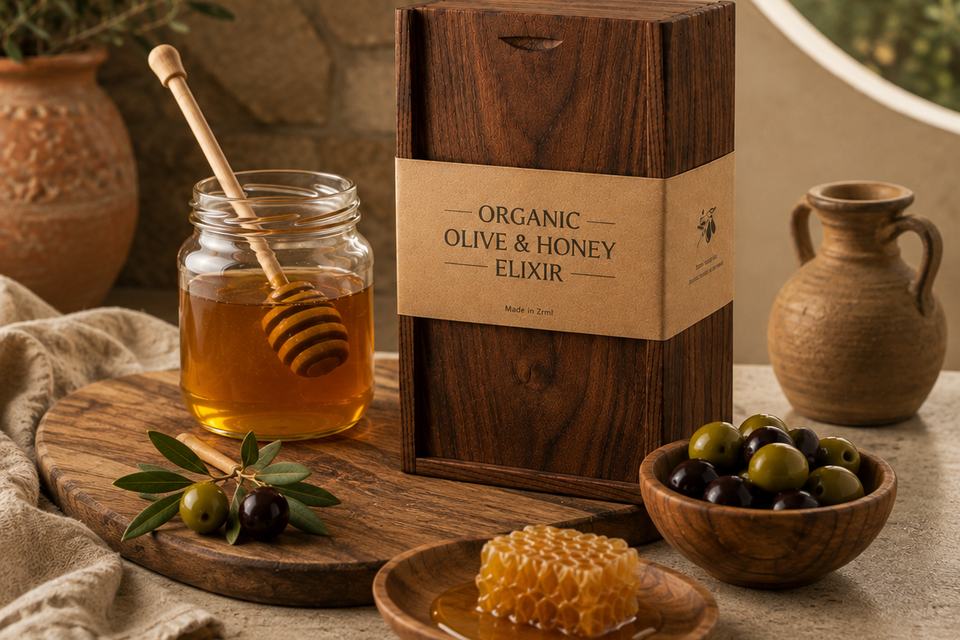
Olive oil and honey both lived on that kind of shelf. Culinary history places the two of them among the oldest staples of the Mediterranean pantry, present in households separated by centuries and by whole coastlines, kept close for the plainest reason available. They were already there.
This brief is about the shelf rather than the jars standing on it. Editorial notes suggest that when a routine quietly disappears, it is usually not the intention that gave way. It is the arrangement around it.
What the brief covers
The letters behind this piece keep pushing back on the same assumption, and the correction is smaller than most people expect.
One fixed point that never has to be scheduled, and what editorial notes suggest happens to the days around it.
In habit journals, some people write a line a week and nothing more, which is often the whole method.
Nothing bought, nothing installed, nothing added to the counter. Readers describe it as the version that survived travel and busy weeks.
The version that lasted was the one I never had to look for. Everything was already sitting where the morning needed it to be, so there was nothing left to decide.
Composite drawn from reader letters. Illustrative only, not attributed to any individual, and not a description of any outcome.
Did you know?
Olive cultivation is among the oldest continuous farming practices in the Mediterranean, and the tree itself works on a timescale that does not match a human working life. A grove set in the ground by one generation is commonly still standing, and still cropping, several generations later.
Culinary history keeps returning to what that did to the household. Groves were inherited rather than acquired, the harvest set the shape of the year more firmly than any calendar did, and a pantry was stocked on a rhythm nobody living had chosen.
The full editorial continues with the kitchen notes, the reader letters that prompted this piece, and the short presentation published alongside it.
Access the editorialEducational content · Third party offer · Sponsored
This policy sets out what information this website gathers, the purposes it serves, and the choices open to the people who visit. Continued use of the site indicates acceptance of the practices described here.
Some information is recorded automatically during a visit, including IP address, the approximate region it points to, browser name and version, device type and operating system, the referring page, the pages opened, and the date and length of the session. Other information is supplied deliberately, for example when a message is sent through a contact form or when someone signs up for updates. Supplying that second kind is entirely optional and the site remains usable without it.
Information supports the running and upkeep of the site, shows which material is read and which is passed over, measures how advertising campaigns perform, allows messages to be answered, and helps identify and stop fraudulent or abusive activity. Aggregated and de-identified figures may also be used for internal reporting.
Cookies, tracking pixels, local storage and comparable technologies are in use here. A portion of them is strictly necessary for the site to function at all. Others serve analytics and advertising measurement, including connecting a visit back to the campaign that produced it. Browser settings can block or clear cookies at any time, though doing so may change how parts of the site behave.
Information is not sold. It may be passed to service providers that run parts of the operation on the operator's behalf, such as hosting, email delivery, analytics and advertising measurement partners, restricted to what each one needs in order to perform its function. Disclosure may also happen where applicable law or valid legal process requires it, or where it is necessary to protect the rights, property or safety of the operator, its visitors or the public. Should the business be merged, acquired or sold, information may move as part of that transaction.
This site does not knowingly gather, request or infer sensitive personal information. Religious belief, health status, medical history and other special categories of data are neither collected nor inferred about visitors. The material published here is general and educational and is not tailored to any individual characteristic.
Depending on the law that applies where a visitor lives, available rights may include asking for a copy of the information held, requesting a correction, requesting erasure, objecting to or limiting certain processing, and unsubscribing from marketing messages. Requests may be sent through the contact page, and reasonable verification may be required before any request is acted on.
Reasonable administrative, technical and organisational measures guard information against loss, misuse and unauthorised access. No method of transmission or storage is entirely secure, so complete protection cannot be promised. Information is held only for as long as the purposes above require, or for as long as applicable law demands.
This site is written for adults. It is not directed at children, and information is not knowingly gathered from them. Anyone who believes a child has submitted information through this site may write through the contact page so that it can be removed.
This site can be reached from many countries, and information may be handled in a country other than the one a visitor is browsing from. Using the site indicates acknowledgement that transfer, storage and processing may occur outside a visitor's country of residence.
This policy may be revised to reflect changes in practice, technology or legal obligation. A revised version applies from the moment it appears on this page, and continued use of the site after that point indicates acceptance of it.
Opening or using this website means accepting these terms in full. Anyone unwilling to accept them should leave the site. The terms apply to every visitor, whether or not an account or a subscription exists.
Material published here may be read, viewed and shared for personal, non-commercial purposes. It may not be copied, republished, resold, scraped, framed or redistributed without written permission. Visitors may not try to obtain unauthorised access to any part of the site or its infrastructure, interfere with its normal operation, upload malicious code, misrepresent who they are, or use the site for any unlawful, deceptive or abusive purpose.
Text, layout, illustration, graphics, code and every other element of this site is protected by intellectual property law and stays the property of its respective owner. Nothing in these terms transfers ownership or grants a licence beyond the limited personal use set out above.
This site carries sponsored content and may include affiliate links. Where a link is followed and a purchase completed, the operator of this site may receive compensation. Certain links lead to websites run by other companies, which are governed by their own terms and privacy policies. The operator of this site neither controls nor accepts responsibility for their content, products, practices or availability.
What is published here is editorial and educational. It concerns food history and ordinary household habits, and any reference to old culinary traditions appears in a historical and cultural context only. It is not medical, nutritional, legal or financial advice, and it is no substitute for professional judgement.
Any decision touching on health, diet or daily routine should be taken with a qualified professional who can weigh individual circumstances. Professional advice should never be set aside or postponed because of something read here. Anyone who believes they are facing a medical emergency should contact emergency services immediately.
The site and its content come as-is and as-available, without warranty of any kind, express or implied, including any implied warranty of merchantability, fitness for a particular purpose, accuracy or non-infringement. There is no promise that the site will run uninterrupted, without error, or free of harmful components.
To the fullest extent the law allows, the operator of this site together with its contributors and suppliers carries no liability for indirect, incidental, special, consequential or punitive damages, nor for lost profits, data, goodwill or opportunity, arising from or connected with use of, or inability to use, this site or any third party site reached from it.
Visitors agree to indemnify and hold harmless the operator of this site against any claim, demand, loss or expense, including reasonable legal costs, arising from their use of the site or from a breach of these terms.
These terms may be amended at any time. An amended version applies once published on this page, and continued use of the site after publication indicates acceptance. This page is worth reviewing from time to time.
These terms fall under the law applicable in the jurisdiction where the site operator is established, without regard to conflict of law rules. Disputes belong to the competent courts of that jurisdiction, except where mandatory local consumer law provides otherwise.
Should any provision of these terms be held unenforceable, that provision will be narrowed or struck only so far as necessary, and everything else stays in full force.